Why AI Governance Starts with Workflow Design, Not Policy Documents
AI governance is often thought of as rules, policies, and documentation. While those are important, they are only part of the picture. Real governance happens when workflows are intentionally designed to enforce oversight, accountability, and safe AI use.
Policy alone doesn’t prevent errors or missteps. Workflows turn abstract rules into concrete actions, ensuring AI is used responsibly at every step.

Governance Is Action, Not Paperwork
Organizations can write all the policies they want, but without structured workflows, humans and AI agents are left to interpret rules on their own. This can lead to:
Inconsistent decisions
Gaps in oversight
Compliance or security risks
Workflow-based governance addresses these challenges by embedding checks, approvals, and accountability directly into operations. Instead of asking teams to read and apply a policy, the workflow ensures governance happens automatically and reliably.
How Workflow Design Enforces Responsible AI
Good workflow design transforms AI governance from theory into practice. Key elements include:
Decision checkpoints: Define where human review or AI agent oversight is required.
Audit trails: Track every action and decision for transparency and accountability.
Error handling: Automatically flag anomalies or exceptions for review.
Iterative improvement: Update workflows as policies or business needs evolve.
For example, a customer support team using an AI agent to triage tickets might:
Automatically flag high-risk tickets for human review
Route routine tasks to AI agents with built-in guardrails
Log all actions and decisions for auditing
With these workflow safeguards, governance is continuous, transparent, and practical, not just a document sitting on a shelf.
Common Governance Challenges and How Workflows Solve Them
Even with strong policies, organizations face real governance challenges:
Fragmented processes: Teams follow different procedures, creating inconsistent outcomes. Workflows standardize these processes across teams.
Unclear accountability: Without defined roles, it’s hard to know who is responsible for decisions. Workflows embed checkpoints and approvals so responsibility is clear.
Delayed detection of errors: Manual oversight can miss mistakes or risky decisions. Workflows flag exceptions in real time.
Scaling risks: Policies may work for small teams but break down at scale. Workflow-driven governance ensures consistent, reliable AI use across the organization.
Designing governance into workflows turns these challenges into actionable solutions, making AI adoption safer and more predictable.
How DataPeak Supports Workflow-Driven Governance
DataPeak helps teams implement governance at the operational level:
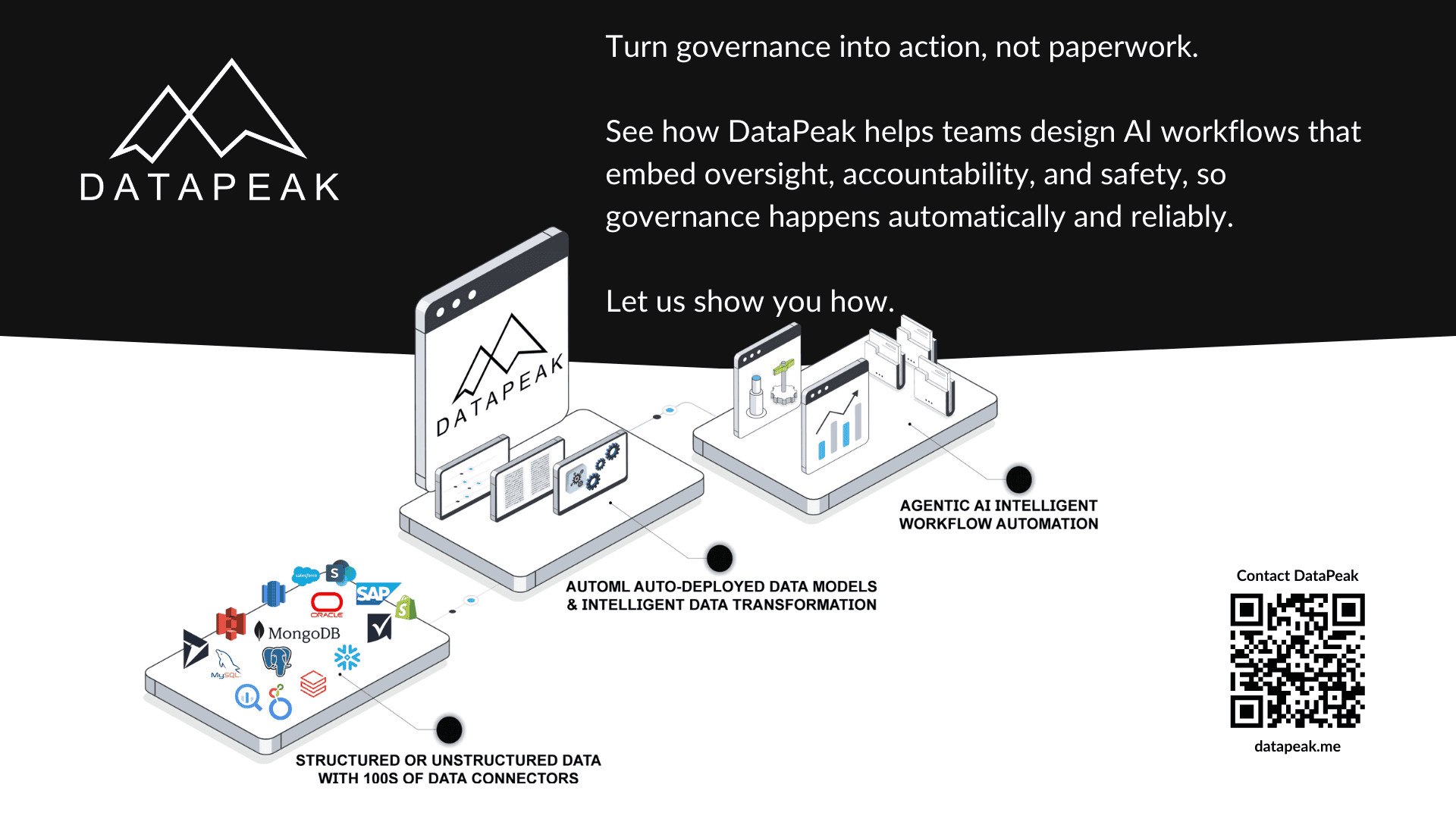
Build structured workflows that embed oversight and accountability
Configure AI agents with rules and guardrails that enforce policies automatically
Track and audit every action for compliance and transparency
Enable safe iteration without introducing risk
By integrating governance into the way work actually happens, DataPeak ensures AI is used responsibly, consistently, and reliably across teams.
Designing Governance That Scales
AI governance works best when it is built into workflows from the start. By designing oversight, checkpoints, and accountability into the way AI is applied, organizations can:
Reduce human error
Maintain compliance and security
Scale AI adoption confidently
Keep humans in control without slowing innovation
Workflow design is governance in action. Policy documents set the principles, but structured, auditable workflows make them real.