Why Models Alone Don’t Deliver Business Value
Analytics and machine learning have become core components of modern business intelligence. Teams build predictive models to anticipate churn, forecast demand, or segment customers. But models on their own don’t deliver measurable business value when they end up as outputs on a dashboard rather than engines of decision and action.
Real impact comes from connecting predictions to structured workflows, reliable data, and operational oversight.

A Model Without Action Is Just Insight
A machine learning model generates predictions or scores, but it doesn’t make decisions for you. Unless these predictions are embedded into how people or systems operate, they remain theoretical.
For example:
A churn prediction model might flag accounts likely to churn next quarter.
Marketing might see the report and discuss it in strategy meetings.
But if there is no process to prioritize outreach, assign tasks, or trigger offers, the insight doesn’t change outcomes.
In this case, the model produces insight, but insight doesn’t automatically become impact. Decision systems—workflows with logic and triggers—are what translate scores into real business outcomes.
Why Workflow Design Matters More
Predictive models are strong at identifying patterns in historical data. But business operations rarely follow neat historical assumptions. To be useful operationally, models need to be tied to structured rules that determine what happens next.
Here’s how teams make that shift in practice:
Validate incoming data so the model isn’t operating on bad inputs.
Convert predictions into decisions by defining what actions to take at different thresholds.
Route tasks or alerts to owners who can act.
Monitor results and refine the system based on outcomes.
In one example, a sales operations team uses a propensity‑to‑buy model. Instead of the model simply being a chart, the prediction flow connects to a workflow that:
Prioritizes leads by likelihood score
Assigns follow‑up tasks automatically
Alerts account executives when confidence drops
Captures outcomes for reporting
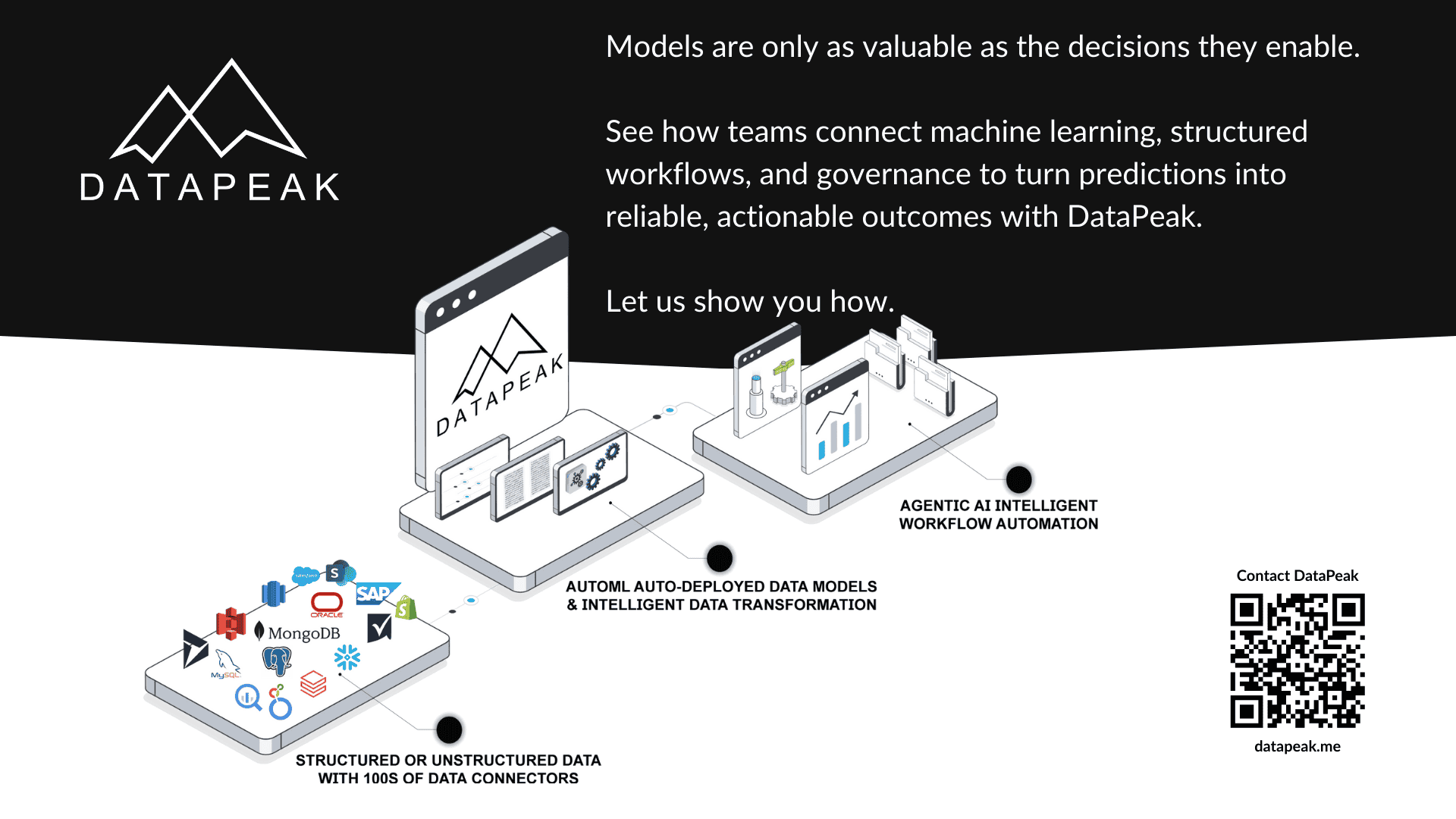
In this kind of system, tools like DataPeak are often used to structure those workflows, linking model outputs to operational steps so that predictions don’t sit alone in dashboards but inform action consistently.
Why Data Quality Determines Model Success
Even the most sophisticated model can’t compensate for poor data. Unreliable inputs, inconsistent schemas, and missing context undermine predictive accuracy and erode trust in outcomes.
Teams that see real value from machine learning do more than train models:
They enforce data standards and validation before prediction.
They ensure data provenance and context are captured so outputs are interpretable.
They manage data governance so users trust the insights they act on.
Viewed this way, a model is a component in a broader system. It is part of a data pipeline that feeds into workflows capable of acting on those results.
When Models Drive Value (and When They Don’t)
Here’s a quick look at where models typically add value:
Good when used to augment decision points that already have clear operational steps.
Better when tied to automated workflows that assign tasks and measure performance.
Best when governance and monitoring ensure decisions are consistent, auditable, and aligned with business goals.
Scarce value often comes from treating models as analytics exercises rather than integrated system inputs.
How Organizations Bridge the Gap
Teams that deliver business impact from models tend to share a few practices:
They treat models as components of workflows, not endpoints.
They use structured decision logic that defines what happens after a prediction.
They build in oversight and governance, so predictions are consistent and reliable.
They measure not just model accuracy but business outcomes.
For example, in demand forecasting, a forecast model might inform inventory decisions. A decision system automatically:
Adjusts reorder levels
Triggers procurement flows
Alerts supply chain teams when thresholds are crossed
This combination of predictive insight + structured workflow steps ensures that outcomes align with business objectives.