Why Most AI Projects Stall After the Demo
AI demos are compelling. The model works, the outputs are impressive, and the possibilities feel immediate.
But a successful demo is not the same as a production system. Many AI initiatives lose momentum not because the technology fails, but because the operational gap is larger than expected.
Closing that gap is what turns excitement into sustained impact.

The Demo Environment Is Designed for Success
Demos are controlled by design. The data is clean. The workflow is simplified. Edge cases are limited. Stakeholders see the best-case scenario.
Production environments introduce a different reality:
Messy, inconsistent data
Cross-system dependencies
Security and compliance requirements
Real performance expectations
Accountability for outcomes
An AI system that performs well in isolation must now function inside a broader operational framework. Without that framework, progress slows.
Where Momentum Breaks
Most projects stall at the same transition point: moving from proof-of-concept to operational integration.
The model may be ready, but key questions remain unanswered:
- Who owns the outputs?
- How are decisions audited?
- What happens when the agent encounters an exception?
- How are workflows updated safely over time?
When these questions aren’t addressed early, teams hesitate to expand deployment. The result is a promising pilot that never becomes infrastructure.
The Operational Gap
The gap between demo and production isn’t about intelligence. It’s about workflow design.
Production systems require:
Clear ownership
Defined escalation paths
Embedded governance
Monitoring and performance tracking
Version control and documentation
AI agents thrive when supported by structured workflows. Without structure, even powerful models remain isolated tools.
Workflow Automation Is the Bridge
This is where workflow automation becomes essential.
Instead of treating an AI agent as a standalone capability, leading teams embed agents into orchestrated workflows that:
Connect multiple systems
Apply role-based permissions
Trigger downstream actions
Track performance and outcomes
When AI is part of a coordinated workflow, it becomes dependable and scalable. Execution and intelligence work together.
Closing the Gap with DataPeak
Teams using DataPeak approach the transition deliberately.
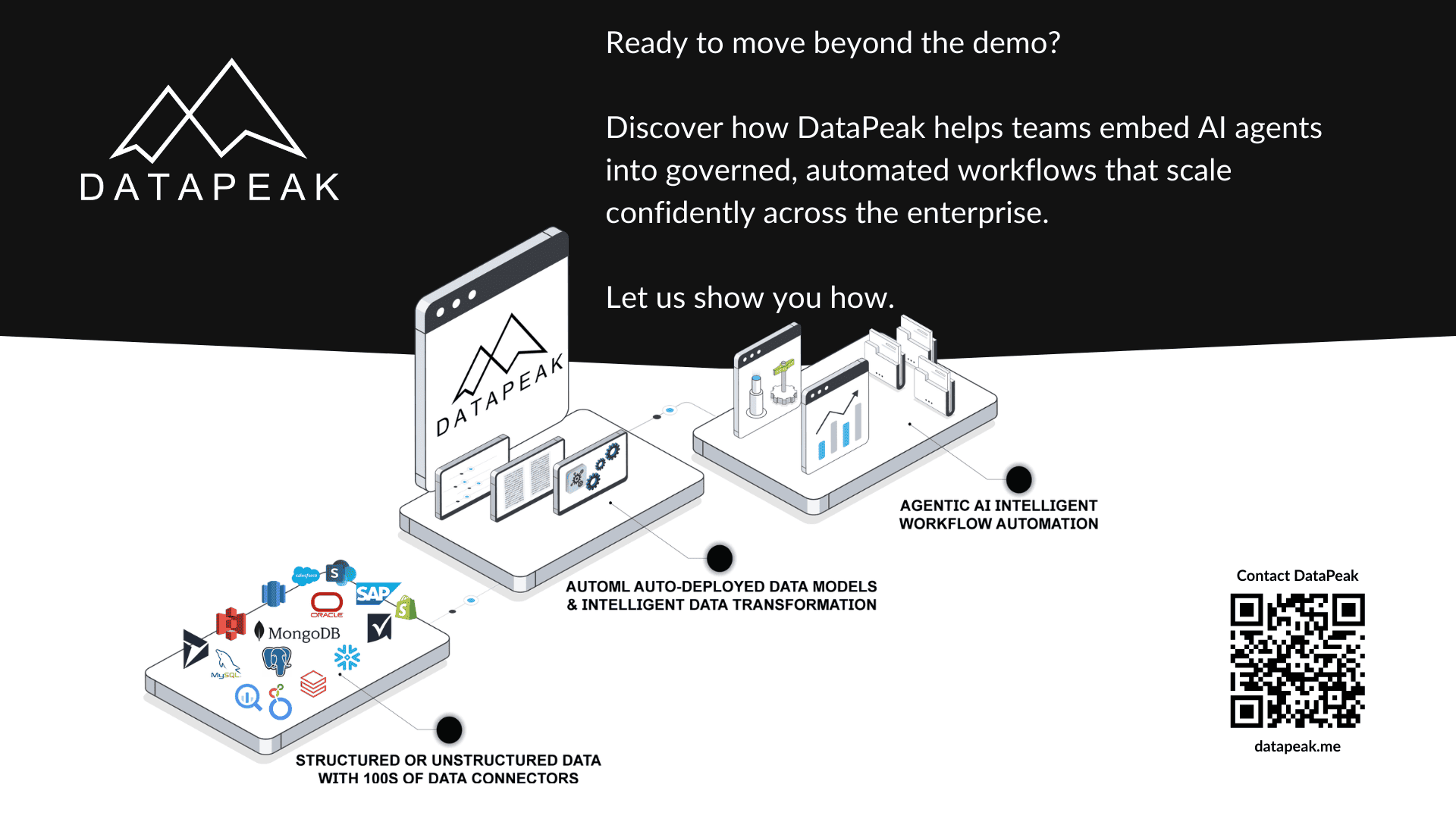
An AI agent might begin as a demo that categorizes incoming support tickets. Within DataPeak, that capability can evolve into a production workflow that:
Applies governance controls automatically
Routes tickets across departments
Logs every decision for auditability
Monitors exception rates in real time
Allows safe updates through versioned workflows
Because workflow automation, monitoring, and governance are built into the platform, teams can scale confidently. The AI agent doesn’t just impress in a demo — it operates reliably within daily business processes.
This is how organizations move from experimentation to operational AI.
Sustaining AI Momentum
The difference between stalled projects and scaled systems is operational maturity.
Teams that succeed treat AI initiatives as infrastructure from the beginning. They design workflows, embed governance, and establish monitoring early. That preparation reduces friction when it’s time to expand deployment.
AI momentum doesn’t disappear because the technology underperforms. It slows when operational foundations aren’t in place.