Integration vs. Orchestration: What’s the Difference?
Integration and orchestration are often treated as the same thing.
They aren't.
Both play an essential role in modern enterprise systems. But they solve different problems, and that distinction becomes more important as automation expands and AI systems become more embedded in daily operations.
One connects tools. The other coordinates outcomes.
What Integration Actually Does
Integration allows systems to exchange data.
A CRM syncs with billing.
An analytics platform pulls from a warehouse.
An API pushes updates between applications.
The goal is simple: remove silos and allow information to flow.
Integration answers a technical question: Can these systems talk to each other?
When they can, efficiency improves. But alignment doesn't automatically follow.
Where Integration Starts to Strain
As integrations multiply, complexity grows.
Data moves across platforms, yet logic remains scattered. Each tool may contain its own automation. Each department may define its own rules. Monitoring becomes fragmented.
You start to see patterns like:
Overlapping automations across systems
Conflicting logic between teams
Limited visibility into cross-system decisions
Manual reconciliation when outcomes don't align
At this stage, systems are connected. They just aren't coordinated.
What Orchestration Changes
Orchestration operates above integration.
Instead of focusing only on connectivity, it defines how processes work across systems. It determines:
How data flows through a workflow
When actions trigger
Who has approval authority
How exceptions escalate
Where decisions are logged and monitored
Integration moves information while orchestration manages intent.
In AI-driven environments, that difference becomes even more significant.
Why It Matters in AI Systems
AI increases decision velocity.
Models generate predictions continuously. Agents evaluate context dynamically. Automated actions trigger in real time.
If integration is the only connective layer, AI outputs may activate isolated automations inside individual tools. Oversight becomes reactive instead of designed.
With orchestration, AI operates inside a structured framework. Guardrails are defined. Escalations are automatic. Decisions remain observable and auditable.
The difference isn't technical. It's operational discipline.
How DataPeak Brings It Together
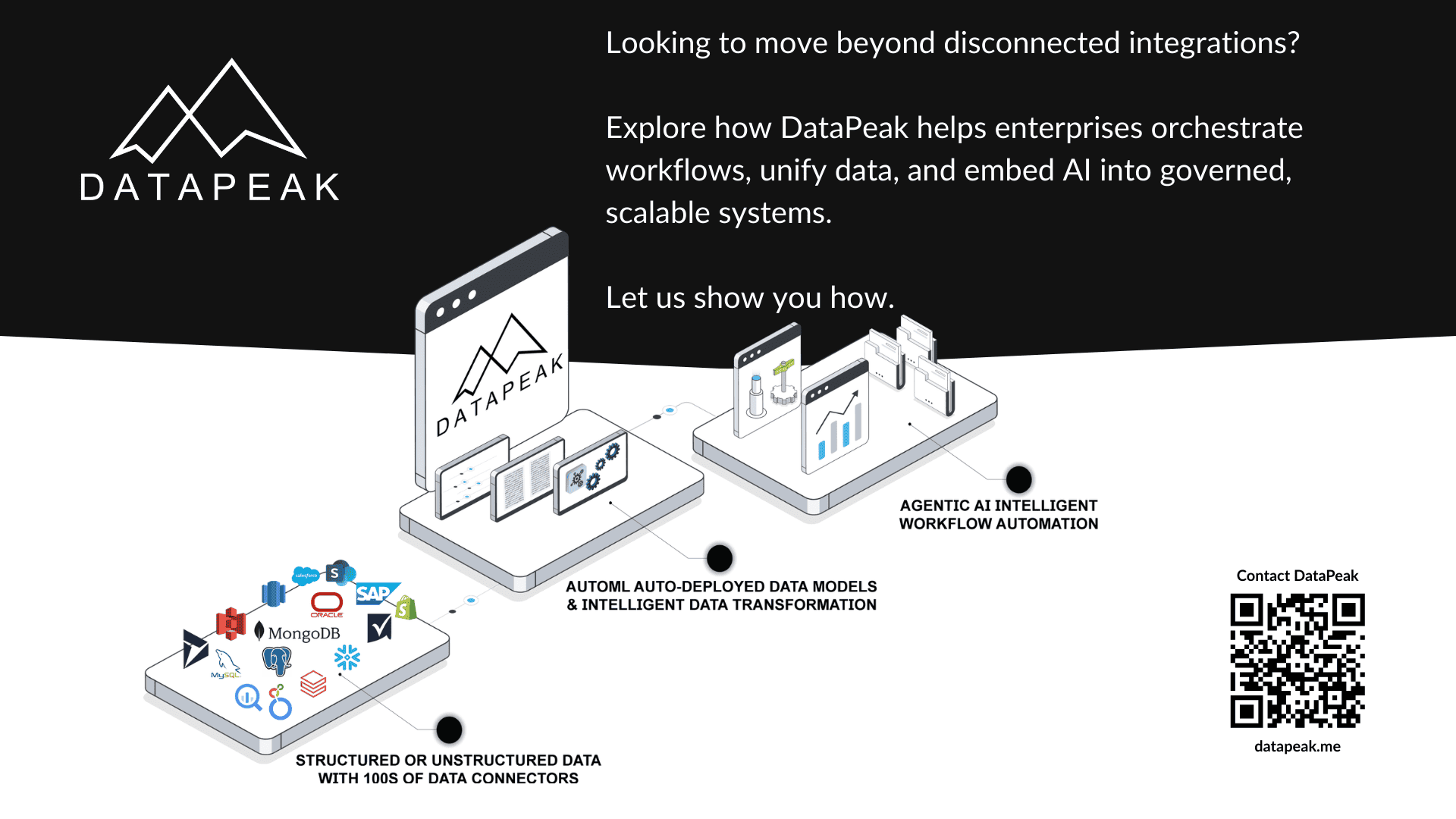
DataPeak combines integration and orchestration within a governed workflow environment.
Organizations can:
Connect systems through structured data pipelines
Design cross-functional workflows visually
Embed AI agents into defined decision points
Apply role-based permissions and operational thresholds
Monitor activity and maintain full audit visibility
Instead of stitching together isolated integrations, teams gain a coordinated operating layer that aligns tools, data, and decision-making.
That alignment is what allows AI systems to scale responsibly.
The Strategic Distinction
Integration is foundational. It connects your technology stack.
Orchestration is directional. It connects your decisions to business objectives.
As enterprises mature, the shift from integration to orchestration marks a move from connected infrastructure to coordinated execution.
That's where intelligent systems begin to deliver measurable impact.