
Predictive Governance: Using AI to Anticipate Risk Before It Happens
The Problem with Reactive Governance
Most governance frameworks still work like smoke alarms, they alert you after something has gone wrong. By the time a data breach, compliance gap, or process failure is discovered, the damage is already done.
But in the AI era, where systems move faster than manual oversight ever could, reactive governance simply isn’t enough. What’s needed is predictive governance, systems that can see risk forming and act before it becomes a problem.

From Monitoring to Anticipation
Governance has traditionally meant monitoring, auditing, and reporting, all essential, but inherently backward-looking. AI changes that equation.
With intelligent pattern recognition, anomaly detection, and contextual learning, AI can now:
Flag unusual data movements that suggest emerging risk.
Predict potential compliance violations before they happen.
Identify weak spots in workflows where controls might fail.
This shift transforms governance from a reactive checklist into a living, learning system, one that continuously improves its ability to protect.
Why Predictive Governance Matters
Every modern enterprise runs on data that moves, across people, tools, and processes. That movement is powerful but introduces constant exposure: unauthorized access, incomplete audits, outdated records.
Predictive governance reduces that exposure by:
Detecting drift — spotting when models or datasets start deviating from policy.
Prioritizing risk — ranking threats by severity and likelihood.
Automating response — triggering remediation workflows instantly when red flags appear.
The result isn’t just faster reaction, it’s prevention built into every stage of data and workflow management.
How AI Makes Governance Proactive
Predictive governance relies on the same core principles as AI analytics: pattern recognition, correlation, and adaptive learning. But instead of predicting customer churn or sales demand, it predicts operational risk.
For example:
A sudden surge in access requests to sensitive datasets → flagged before a potential leak.
A workflow agent behaving outside normal parameters → isolated for review.
A model’s accuracy dropping below threshold → triggering retraining before results degrade.
AI learns from these signals over time, strengthening governance as the system evolves.
The DataPeak Difference: Anticipate, Don’t React
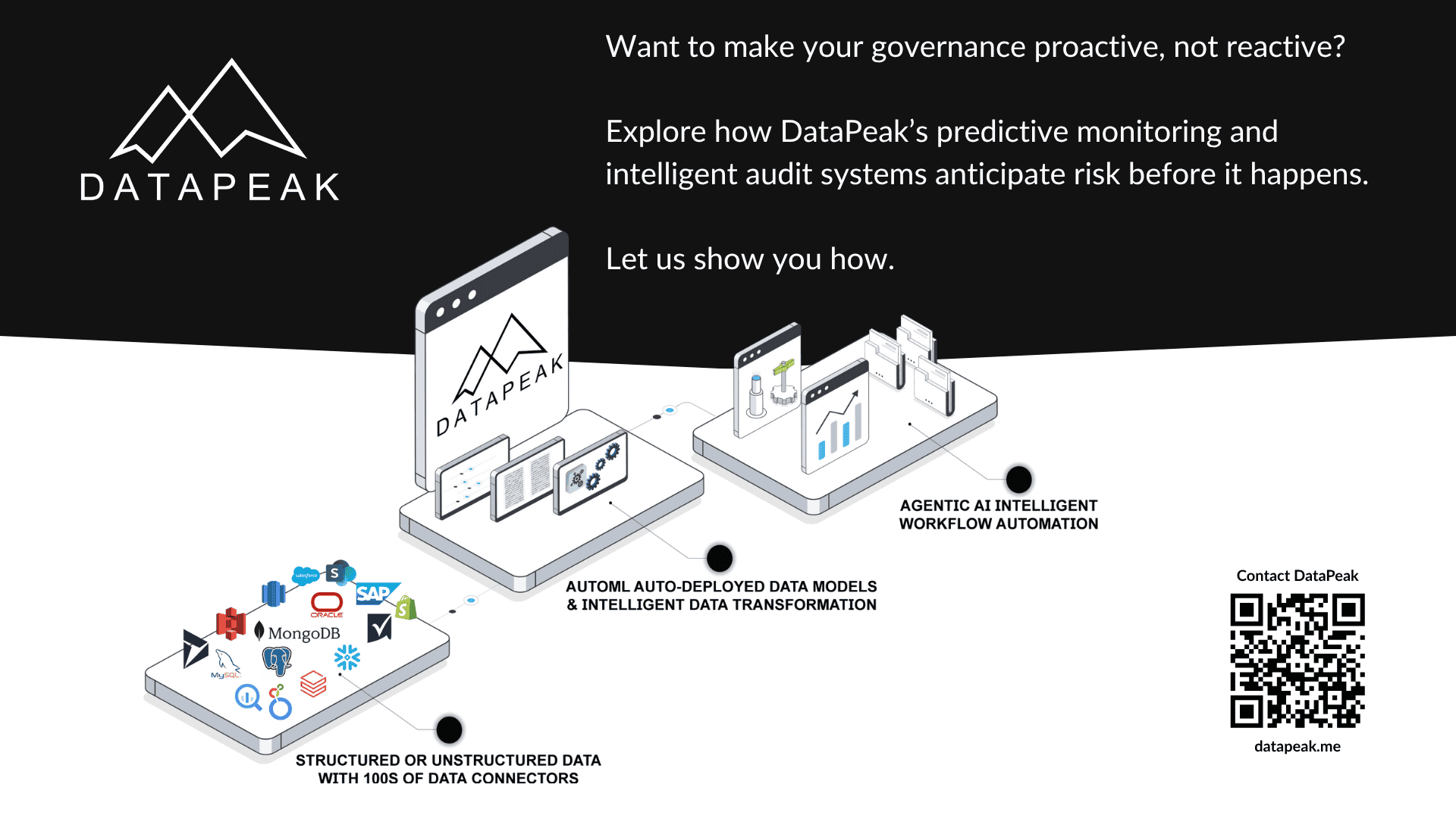
DataPeak was designed for exactly this kind of proactive oversight. Its agentic AI architecture continuously monitors data movement, workflow behavior, and system health, identifying issues before they impact compliance or performance.
Inside the platform:
Intelligent audit trails surface anomalies in real time.
Automated workflows trigger internal reviews before escalation.
Governance dashboards highlight risk trends, not just incidents.
It’s governance that doesn’t wait for an audit, it acts before one is needed.
From Reactive to Resilient
The difference between a compliant organization and a resilient one is simple: foresight. Predictive governance helps organizations build that foresight into every system they deploy.
By giving teams visibility into risk before it materializes, AI allows compliance to become a strategic advantage, not an afterthought.
Seeing Around Corners
In an increasingly automated world, the organizations that thrive will be those that can see around corners, identifying weak points, predicting issues, and adapting in real time.
Predictive governance isn’t the future of compliance. It’s the bridge between intelligence and integrity and it’s already here.
Keyword Profile: predictive governance, AI risk detection, intelligent audit, proactive compliance, DataPeak governance AI