Why Rule-Based Automation Breaks at Scale
Rule-based automation is straightforward by design.
Define a condition. Trigger an action. Repeat.
In controlled environments, that logic holds up. But enterprise systems rarely stay controlled for long. As complexity grows, static rules begin to strain under the weight of real-world variability.
The issue isn’t that rules are wrong. It’s that scale changes the environment they operate in.

Complexity Compounds
At small scale, workflows follow predictable paths. Inputs are limited. Exceptions are manageable.
As organizations expand, variability increases.
New data sources are introduced. Policies evolve. Edge cases multiply. Customer behavior shifts. Teams operate across regions and systems.
Every new scenario requires another rule. And another. Over time, logic stacks grow dense. Dependencies overlap. Updating one condition risks unintended consequences somewhere else.
The system still functions. It just becomes fragile.
Static Logic Doesn’t Adapt
Rule-based systems rely on predefined pathways. They execute exactly what they’re told.
But enterprise environments don’t stay static. Market conditions shift. Risk thresholds change. Operational priorities evolve.
Rules require manual updates to reflect those shifts. When change accelerates, maintenance becomes constant. Innovation slows because teams hesitate to touch brittle logic.
That’s where scale begins to expose the limits of static automation.
From Rigid Rules to Intelligent Coordination
Scaling automation requires more than adding more rules. It requires coordination.
Orchestrated workflows connect systems, data, and decisions in a structured way. AI agents add contextual evaluation, allowing systems to respond based on patterns and probability, not just fixed conditions.
Instead of expanding decision trees endlessly, intelligent systems evaluate multiple variables at once and operate within defined guardrails.
Control remains. Adaptability increases.
How DataPeak Enables Scalable Automation
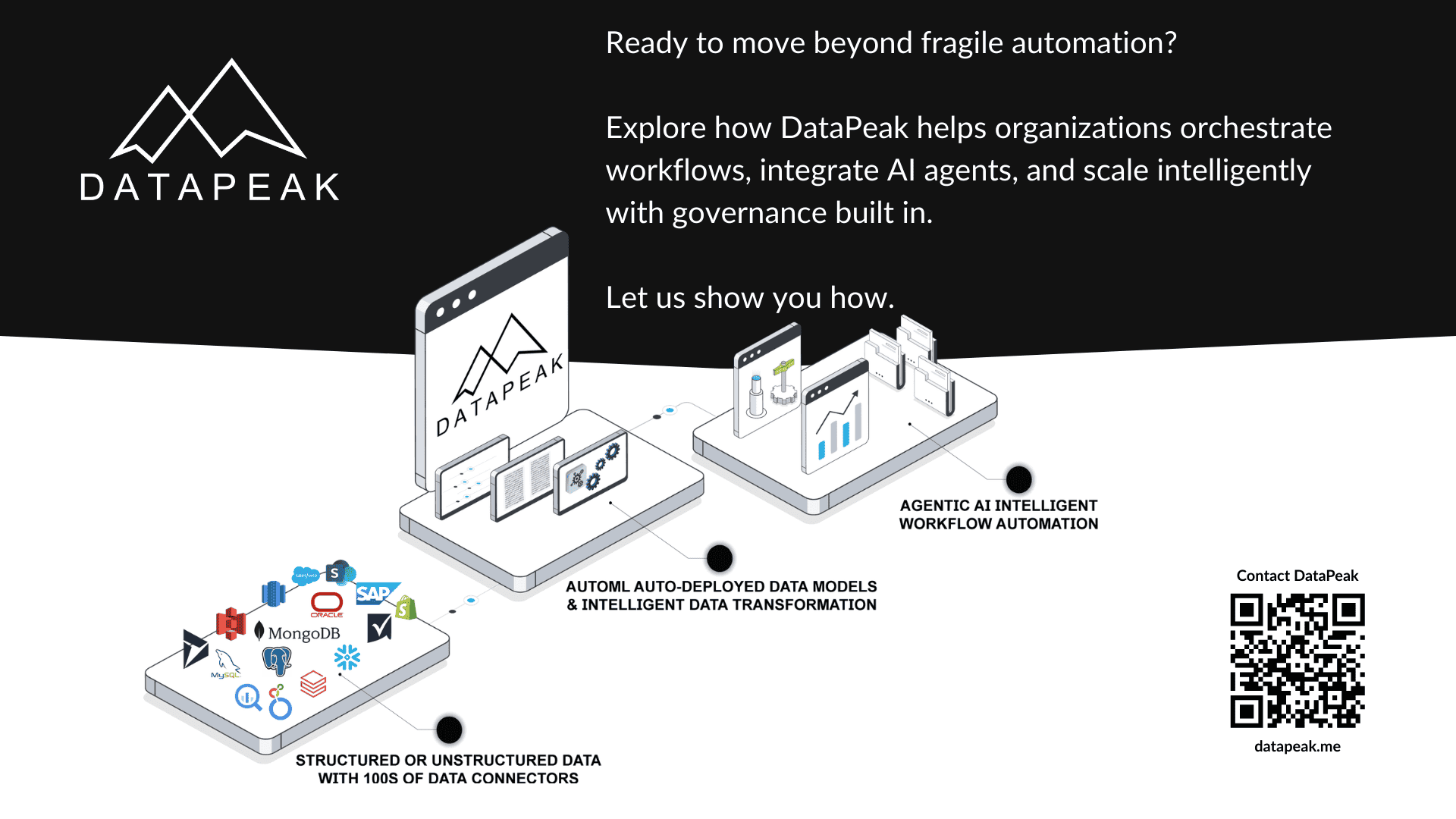
DataPeak helps organizations move beyond isolated rule stacks by embedding AI agents within governed workflow architecture.
The platform unifies data management and workflow automation in a single environment, giving teams the structure they need to scale intelligently. With DataPeak, organizations can:
Design workflows visually without creating brittle point integrations
Define role-based permissions and governance controls from the start
Configure AI agents to operate within approved thresholds
Route exceptions automatically to the right stakeholders
Monitor decisions in real time with full audit visibility
Rules do not disappear. They operate inside a coordinated orchestration layer that is observable, adaptable, and easier to evolve.
That structure allows automation to grow with the business rather than becoming fragile as complexity increases.
Scaling Without Fragility
Automation is essential to modern enterprises. But resilience matters as much as efficiency.
When workflows are orchestrated, data is unified, and AI agents operate within defined governance controls, automation becomes sustainable. Systems adapt without constant rewrites. Teams innovate without fearing unintended ripple effects.
That’s how organizations scale intelligently.