
What Is DataPeak? A Simple Introduction to the Platform
Modern businesses generate more data than ever, yet many still struggle to turn that data into reliable decisions and repeatable workflows.
The problem isn’t a lack of tools. It’s fragmentation. Data lives in one place, workflows in another, and decision-making often depends on manual effort or brittle automation. As systems grow more complex, so does the effort required to keep them running.
DataPeak was built to solve this problem.
This article provides a clear introduction to what DataPeak is, how it works, and why it’s designed differently from traditional data and automation tools.

What Is DataPeak?
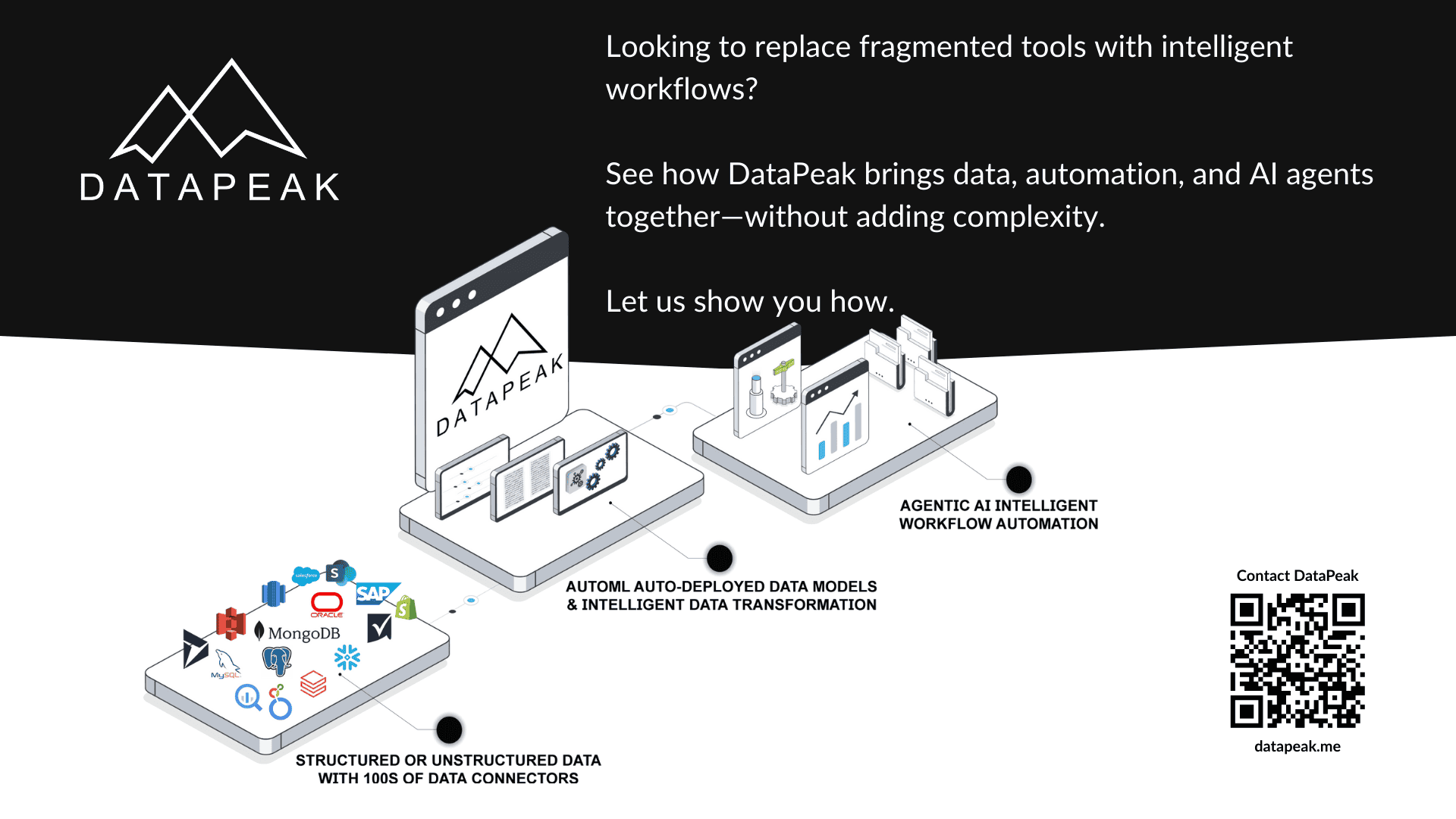
DataPeak is a no-code platform for building AI-driven workflows that combine data, automation, and agentic AI in one system.
Instead of stitching together disconnected tools, DataPeak provides a single environment where teams can:
Organize and manage data
Build workflows visually
Create AI agents with defined roles
Automate decisions and actions
Generate outputs that teams can trust
The platform is designed for real business use, not experimentation without guardrails.
The Problem DataPeak Solves
Most organizations don’t suffer from a lack of technology. They suffer from:
Tool sprawl
Fragile integrations
Manual handoffs
Limited visibility into how decisions are made
Traditional automation handles predictable tasks well, but breaks down when judgment is required. AI tools offer intelligence, but often operate in isolation, without structure or oversight.
DataPeak bridges that gap by bringing data, workflows, and AI agents together in a governed, no-code environment.
How DataPeak Is Different
DataPeak is not:
A single-purpose automation tool
A standalone AI model
A chatbot platform
A traditional analytics dashboard
Instead, it’s a system for building systems.
At its core, DataPeak is designed around orchestration, the idea that intelligent workflows require both structure and flexibility.
The Core Building Blocks of DataPeak
While DataPeak supports a wide range of use cases, everything is built from a small set of consistent components.
Data as the Foundation
DataPeak starts with structured data.
Teams can:
Create and manage datasets
Import data from files, databases, or APIs
Clean and transform information
Maintain clear data relationships
This structured foundation is what allows workflows and agents to operate reliably.
If your starting with unstructured data, DataPeak can help you get it into structured form for use and analysis.
Workflows That Orchestrate Logic
Workflows define how work moves through the system.
In DataPeak, workflows:
Connect data inputs to actions
Control execution order
Apply business rules
Ensure repeatability and transparency
Workflows act as the backbone that keeps automation and AI aligned with business logic.
AI Agents That Make Decisions
AI agents in DataPeak are designed to operate within workflows, not outside them.
Agents can:
Observe data and context
Evaluate conditions
Decide which action to take
Trigger workflows or request human input
Evaluate outcomes before continuing
This approach allows teams to automate decision-making without sacrificing control.
Outputs Teams Can Use
The end result of any workflow is an output, and DataPeak treats outputs as first-class citizens.
Outputs may include:
Generated reports
Structured data updates
Notifications
Files and exports
Triggered downstream processes
Each output is traceable, auditable, and tied back to the workflow that produced it.
Who DataPeak Is For
DataPeak is built for teams that need more than isolated automation or ad hoc AI tools.
It’s particularly well suited for:
Operations teams managing complex processes
Data teams supporting multiple stakeholders
Product teams building internal systems
Organizations handling documents, analytics, or supply-chain workflows
Businesses adopting AI responsibly, not recklessly
The platform is designed to support both technical and non-technical users, enabling collaboration rather than dependency.
Why No-Code Matters in DataPeak
No-code in DataPeak is not about simplicity for its own sake. It’s about access and governance.
By building workflows visually, teams can:
Understand how systems work
Review logic collaboratively
Adjust behavior without redeploying code
Maintain oversight as systems evolve
This makes DataPeak suitable for long-term operational use, not just prototypes.
How DataPeak Fits Into Modern AI Adoption
AI adoption often fails when intelligence is added without structure.
DataPeak takes the opposite approach:
Structure first
Intelligence second
Autonomy only where appropriate
This philosophy allows organizations to introduce AI agents gradually, expand their role responsibly, and maintain trust in automated decisions.
DataPeak exists to make intelligent workflows practical.
By combining data, workflows, and agentic AI in a single no-code platform, it helps teams move beyond fragmented tools and manual decision-making, without sacrificing control or accountability.
That’s what makes DataPeak different.
Keyword Profile: